
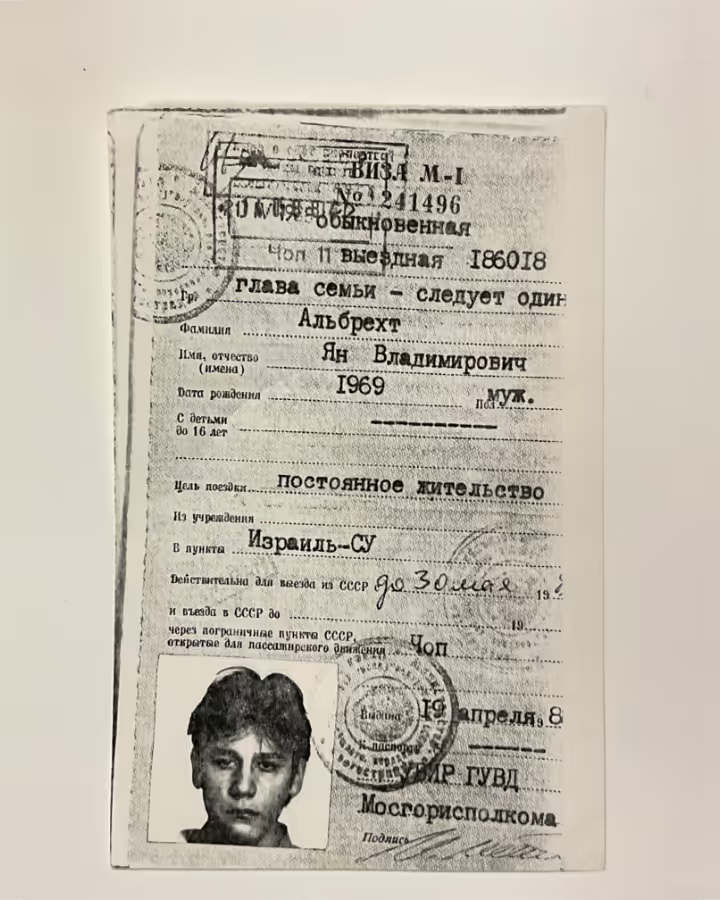

I have been stateless. So what? Now I have two passports.
The first chapter of my immigration-themed biography is categorically unsentimental. I grew up within uncrossable borders. There was over here and there was over there. The Russian noun for “abroad”—zagranitsa—literally means “beyond the border.” Ordinary mortals who had made that roundtrip were worshipped as deities. Border crossing for permanent departure was considered an irreversible event on par with death, and was officially recorded accordingly. An exit visa was a one-way ticket both to a foreign state and to another way of being: stateless.
On those terms, when leaving the Soviet Union at the age of eighteen, I learned my first immigration law lesson. It could have been a trick question on a Euclidean geometry exam: does one need a transit visa to pass through country C by train, if one holds an exit visa from S and an entry visa for A? (A = Austria, C = Czechoslovakia, S = Soviet Union.) I didn’t have it. Since then I have immigrated to and lived in three countries, without such mishaps. As a serial immigrant, I arrived at a global understanding: the exceptions make the rules worth knowing.
Immigration law was never a career destination or even a general direction. It was a random stop. I had graduated from college with a degree in literary studies. I desperately needed a job that didn’t involve food service. I found a job as an immigration paralegal. One job led to another and then to another, which led to a discovery: I was good at this and I liked it. In hindsight, the connection between my college degree and the job was not a coincidence. Both require working with texts, examining their structures, making arguments about their meaning. There was something strangely comforting about reading immigration law manuals thousands of pages thick—for gainful entertainment on the employer’s dime—and seeing them for what they are: texts. I was trained to handle those. Scavenging for spare parts from these semiotic junkyards. Forms hiding substance. Forms over substance.
I became a lawyer long before I could legally call myself a lawyer. Early in law school, I started a business as a freelance paralegal. My clients were immigration lawyers and small law firms all over the U.S. My service model was inverted: they expected me to guide them and win cases for them. To justify charging higher fees, I was selling them a more capable version of themselves. Back then a freelance paralegal was an outlier. I was a ghostwriter of narratives that gave lost causes a fighting chance. I was a fixer of form-filling screwups. I was a filer of the unfilables. I was a combat medic performing CPR on doomed labor certifications in a world of unspeakable malpractice. The support letter templates I wrote in those years are still in circulation. That experience taught me what law school didn’t: law is a trade aspiring to craft, best learned through practice; the law degree is overrated; and a law license without judgment is a weapon of mass destruction.
I carried these lessons into my own law practice. Over time these lessons have crystallized into certain working principles. The principles have matured into a style.
Winning is not the goal. It is the floor. Not losing is the harder discipline. It means eliminating every reason for a denial within my control, which leaves luck as the only remaining uncertainty. Approvals are routine. Denials are examined, answered, and remembered.
What’s wrong with making cases approvable? you may ask. Surely approvable is good enough. Yes, so is edible, drinkable, wearable, habitable, passable, tolerable, arguable. There’s no poetry in that, no joy. Approvable aspires to nothing. It is flat. It also shares a permanent border with deniable. Undeniable draws its own maps. It is three-dimensional. I choose undeniable.
The denial record. How I count, what counts.
I publish every application or petition I have lost, by year, since the start of my practice in 2006. How I count matters.
A denial on the merits by USCIS, the Department of Labor, or the Department of State.
Cases I refile rather than appeal.
Cases the client decides not to appeal.
Denials reversed on appeal.
Cases already denied before the client hired me, where the appeal fails.
Denials caused by the client’s own conduct against my instructions or outside my knowledge and control.
Procedural closures where the case never reached the merits. Administrative outcomes, not substantive ones.